HEGERLS Warehouse Automation Solutions & High-Density Storage Systems

 read
read Warehouse racking systems are storage structures designed around a particular load unit, access method, inventory profile and handling process. Common types include selective pallet racking, double-deep racking, drive-in or drive-through racking, pallet shuttle racking, pallet-flow racking, mobile racking, carton-flow shelving, long-span shelving, cantilever racking, mezzanine systems and automated high-bay racking.
The right rack is not simply the option with the most positions. Selection must balance storage density, direct access, FIFO or LIFO rules, throughput, forklift or automation interfaces, building limits and safety.
|
Racking type |
Typical load |
Access and rotation |
Main design trade-off |
|
Selective pallet racking |
Pallets |
Direct access; flexible rotation |
More forklift aisles |
|
Double-deep pallet racking |
Pallets |
Second pallet behind first |
Higher density, lower selectivity |
|
Drive-in / drive-through |
Pallets |
Deep lanes; LIFO or FIFO by layout |
Dense storage, slower individual access |
|
Pallet shuttle racking |
Pallets |
Shuttle moves loads inside lanes |
Dense storage with equipment dependency |
|
Pallet-flow racking |
Pallets |
Gravity lanes; commonly FIFO |
Lane discipline and load quality required |
|
Mobile racking |
Pallets or shelves |
Movable rows open the required aisle |
High density with powered moving structures |
|
Carton-flow racking |
Cartons and totes |
Gravity-fed picking; commonly FIFO |
Best for controlled container sizes |
|
Long-span shelving |
Cartons and medium items |
Direct manual access |
Manual-handling limits |
|
Cantilever racking |
Long or irregular items |
Open-front access |
Requires load and arm engineering |
|
Mezzanine / multi-tier |
Cartons, parts, work areas |
Multiple operating levels |
Building, egress and material-flow coordination |
|
High-bay automated racking |
Pallets or totes |
Machine-served locations |
Integrated automation and tight tolerances |
|
Clad-rack warehouse |
Project-specific |
Rack supports storage and building envelope |
Early structural commitment |
Selective pallet racking uses upright frames and horizontal beams to create individual pallet positions. A forklift can normally reach each position without moving another pallet.
It is a practical choice for many SKUs, frequent access and operations that value flexibility. The trade-off is aisle space. Narrow-aisle variants can reduce aisle width but require suitable trucks, guidance, floor tolerances and operating procedures.
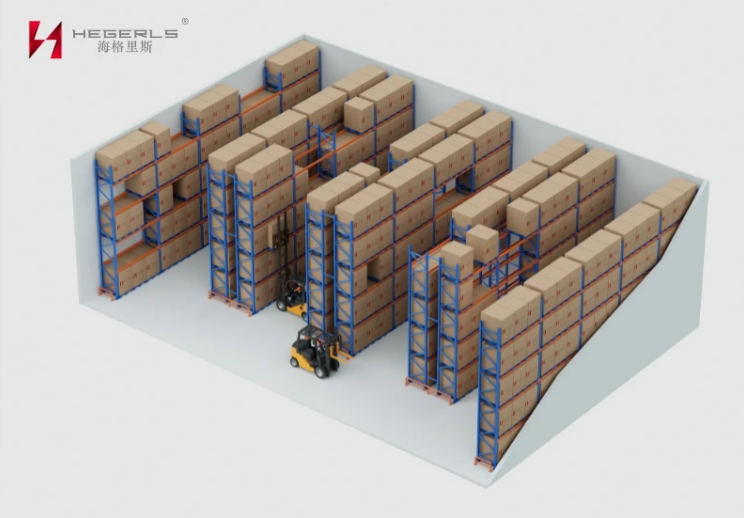
Double-deep racking stores one pallet behind another. It increases storage depth while retaining an aisle-based layout, but the rear pallet is not directly accessible.
The system suits stock profiles that can tolerate paired pallet locations. It requires compatible reach equipment and careful slotting. It should not be selected where every pallet must remain immediately accessible.
In drive-in racking, a forklift enters the rack lane and places pallets on support rails. With one open face, the layout commonly operates as LIFO. A drive-through layout has access from both ends and may support FIFO when the process is controlled accordingly.
These systems suit larger quantities of fewer SKUs with compatible pallets. Density improves because many access aisles are removed, but lane access is slower and the forklift operates close to rack components. Guides, protection and disciplined loading are important.
Pallet shuttle racking uses a shuttle cart to move pallets within deep lanes. A forklift or automated transfer device handles the lane entrance, while the shuttle performs internal lane travel.
It reduces the need for forklifts to enter the rack and can support deep storage. FIFO or LIFO capability depends on whether the lane is served from one or both sides and how inventory is allocated. Shuttle availability, batteries, controls and recovery procedures become part of the operating plan.
Pallet-flow racking places pallets on inclined roller or wheel tracks. Loads enter from the replenishment side and move by gravity toward the retrieval side. The arrangement is commonly used for FIFO rotation.
The rack must be designed for pallet type, weight, speed control and lane depth. Damaged or inconsistent pallets can disrupt flow, so pallet inspection and braking or separation devices deserve attention.
Mobile racking mounts rack rows on powered bases that move along floor rails. Most aisles remain closed, and the system opens the aisle required for access.
This can provide dense storage while retaining selective access, but only one or a limited number of aisles may be open at a time. Floor rails, controls, emergency systems, aisle-clearance detection and operating speed must be included in the evaluation.
Carton-flow racking uses inclined tracks to feed cartons or totes from replenishment to the picking face. It separates replenishment and picking activities and is commonly arranged for FIFO.
It works well for controlled container sizes and repeatable picking. Track spacing, carton base quality, lane dividers, presentation angle and pick-face ergonomics should be tested with actual products.
Long-span shelving provides wider shelf bays for manually handled cartons, components and medium-size items. Shelves may use steel panels, boards or other project-specified decking.
It suits spare-parts storage, workshops and manual picking areas. Shelf loading, item dimensions, reach height and manual-handling limits determine the configuration.
Cantilever racks use columns and projecting arms rather than front uprights. The open face suits pipes, profiles, timber, panels and other long or irregular loads.
Arm length, load distribution, column spacing, base design and handling equipment must match the product. Bundles should be stable and restrained where necessary; a nominal total weight alone is not enough to design the rack.
Mezzanine racking creates additional operating levels using rack-supported or independent steel structures. It can combine shelving, picking, packing and conveyors within the building height.
The design must coordinate floor loading, stairs, guards, gates, egress, fire protection, lighting and transfer of goods between levels. Usable area is only valuable when people and materials can move safely through it.
High-bay AS/RS racking is engineered to work with stacker cranes, shuttles, conveyors and warehouse controls. Machine interfaces and tolerances are more demanding than in a conventional forklift-served rack.
The rack, load carrier, equipment, sensors and software must be treated as one system. System throughput depends on the machines and transfer stations as well as the number of storage positions.
In a clad-rack or rack-supported warehouse, the rack also supports roof and wall loads. This is not merely another internal rack layout; it is an integrated storage building.
Foundation reactions, wind, snow, seismic actions, cladding, automation, fire protection and construction sequence must be coordinated early. Major later changes require structural review.
Record pallet, tote, carton or long-load dimensions, weight, support points, deflection, overhang and condition. Mixed or damaged pallets may need additional controls.
Count SKUs, pallets or cartons per SKU, stock depth, turnover, batch and expiry rules. Deep-lane systems work best when enough inventory can fill lanes without excessive mixing.
Confirm direct-access needs, replenishment method, FIFO, LIFO or FEFO rules and average and peak movements. A dense design can underperform if frequent reshuffling is required.
Measure clear height, columns, doors, docks, floor capacity and flatness, fire constraints and egress. Confirm forklift type, turning radius, lift height and required aisle width, or define the automated equipment interfaces.
For each concept, compare usable storage positions, access, travel distance, staging, safety zones, expansion and total project scope. Do not compare rack price per bay before confirming that the concepts solve the same operational requirement.
Rack design should follow the applicable codes and qualified engineering requirements for the project location. The Rack Manufacturers Institute publishes standards and rack-safety guidance in the United States, while OSHA identifies warehouse material-storage and handling hazards. Other countries and rack types may require different standards.
After installation, record the approved configuration and load notices. Train operators to report impact and damage. Arrange inspection and repair procedures appropriate to the system. Do not change beam levels, add decking, relocate racks or alter loads without checking the effect on the engineered design and fire protection.
Selective pallet racking normally provides direct access to each pallet position, subject to aisle and handling-equipment design.
Drive-in, shuttle, pallet-flow and mobile systems are common candidates. The best fit depends on SKUs, lane depth, access, rotation and throughput.
Pallet-flow and carton-flow systems are commonly configured for FIFO. Drive-through and shuttle designs may also support FIFO when access and software rules are designed for it.
Cantilever racking is commonly used for long or irregular loads such as pipes, profiles, panels and timber.
Sometimes, but structure, tolerances, load supports, clearances and equipment interfaces must be assessed. Do not assume a forklift rack is suitable for automated equipment.
HEGERLS lists warehouse racking systems for pallet, carton, long-load, high-density, multi-level and automated storage. The appropriate layout depends on the actual loads, inventory, building and operating method.
For a project discussion, send your warehouse drawing and clear height, load dimensions and weights, SKU and inventory profile, throughput, forklift details, storage environment and FIFO or LIFO requirements through the project enquiry page.


