HEGERLS Warehouse Automation Solutions & High-Density Storage Systems

 read
A pallet rack is an engineered storage structure that holds palletized unit loads in horizontal rows and vertical levels. It uses upright frames, load beams and related components to transfer the weight of stored goods to the floor while allowing forklifts or automated equipment to place and retrieve pallets.
Pallet rack is not one fixed layout. Selective, drive-in, pallet-flow, mobile and shuttle-supported systems arrange pallets differently to balance access, density, stock rotation and movement capacity.
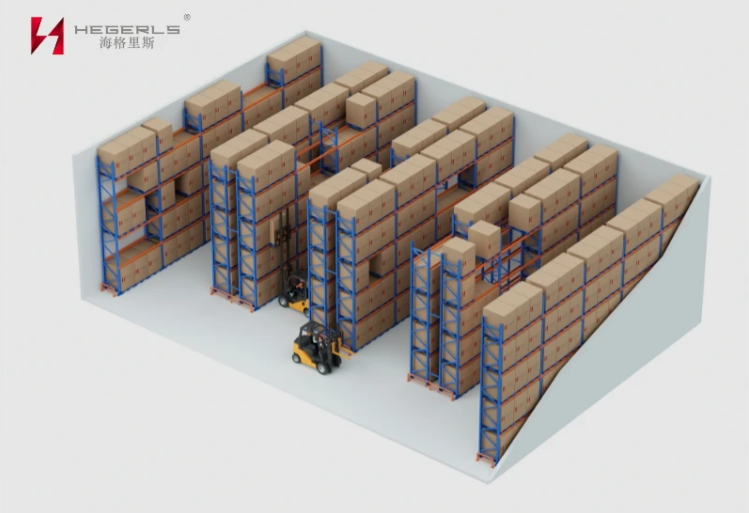
HEGERLS Pallet Racking System
In a typical beam rack, pallets rest on a pair of horizontal beams connected to upright frames. The load travels through the pallet and beams into the uprights, anchors and floor. Bracing stabilizes the frame, while beam connectors and locking devices keep each level in its intended position.
A forklift approaches the rack, lifts the pallet above the selected beam level and places it squarely in the storage position. Retrieval reverses the sequence. The process sounds simple, but safe operation depends on compatible pallets, defined load dimensions and weights, suitable clearances, trained operators and an undamaged structure.
Other pallet rack types change the access method. In pallet-flow rack, gravity rollers move loads from the loading side toward the picking side. In drive-in rack, a lift truck enters a storage lane. In shuttle rack, a powered carrier moves pallets within a deep lane while the forklift works at the aisle face.
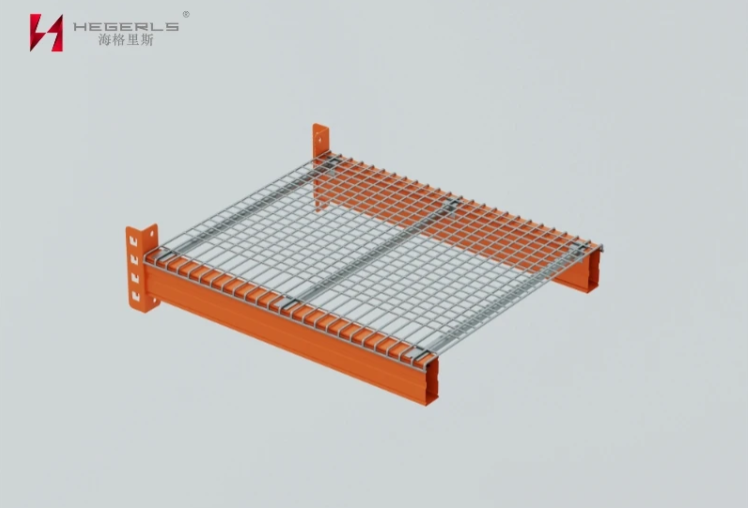
Detailed view of pallet support
| Component | Purpose |
| Upright frame | Supports the vertical load and includes posts, bracing and base plates |
| Load beam | Spans between uprights and supports a pallet level |
| Beam connector and lock | Connects a beam to an upright and helps prevent accidental displacement |
| Anchor | Fixes the rack base to the approved floor system |
| Pallet support or deck | Provides project-specific support where required by the load or pallet |
| Row spacer | Maintains the designed distance between back-to-back rows |
| Protector or guard | Helps reduce impact exposure at vulnerable locations |
| Capacity notice | Communicates the approved load and configuration limits |
Accessories do not change the approved load path. Decking and supports still require compatibility checks for the pallet, load and fire-protection design.
Selective rack gives a truck direct access to each pallet position from an aisle. It is flexible for many SKUs and frequent access, but the aisles consume floor space. It is often the baseline against which denser concepts are compared.
Double-deep rack stores two pallets in depth. It reduces the number of aisles but requires suitable reach equipment and leaves the rear pallet dependent on the front position. It works better where multiple pallets are held for each SKU.
These systems create deep lanes supported by rails. Drive-in normally uses one access face and often follows last-in, first-out rotation. Drive-through has access at both ends and may support first-in, first-out flow when replenishment and retrieval are separated. Both require disciplined pallet and lane management.
Pallet-flow rack uses inclined rollers or wheels. Loads enter at the higher side and move toward the discharge side as the front pallet is removed. It can support first-in, first-out rotation but requires compatible loads, speed control and careful testing.
Push-back rack stores pallets on nested carts or inclined lanes. Loading a new pallet pushes earlier pallets deeper, and unloading allows the next pallet to move forward. It offers denser storage with aisle-face access, generally using last-in, first-out rotation.
Mobile rack places rack rows on powered bases so only the required aisle opens. Shuttle rack uses a carrier within deep lanes. Both can raise storage density, but controls, floor conditions, throughput, evacuation and maintenance need project-level evaluation. See the broader HEGERLS warehouse racking type comparison for additional system distinctions.
The terms are often used interchangeably. In practical design, however, a pallet rack may refer to the physical structure, while a pallet racking system includes the structure, load units, aisles, handling equipment, protection, operating rules and interfaces with the building.
This wider view matters. A rack can fit geometrically but still fail the operation if the forklift cannot turn, replenishment blocks picking, staging is undersized or inventory rotation conflicts with the lane design.
Start with the load. Record pallet type, width, depth, loaded height, maximum weight, load distribution, overhang, stability and any special environmental conditions. Use maximum approved values rather than averages.
Next, analyze the inventory. Key inputs include SKU count, pallets per SKU, stock variation, batch and expiry rules, access frequency and average and peak inbound and outbound movements. High SKU variety often favors direct access; repeated pallet quantities may justify deeper lanes.
Then confirm the handling method. Forklift turning radius, lift height, mast clearance and capacity affect aisle width and rack height. Automated storage equipment requires additional attention to tolerances, positioning, load identification, sensors and system interfaces.
Finally, evaluate the building and complete workflow. Check clear height, columns, docks, doors, staging, egress, floor capacity and condition, lighting and fire protection. Compare proposals by usable pallet positions, travel, throughput, access, resilience and lifecycle scope, not simply by the number of frames or price per bay. The HEGERLS warehouse racking systems overview outlines the project information used to develop a layout.
Pallet rack must be designed, installed and used according to the applicable standards, building requirements and qualified engineering review for the project location. Load notices should match the approved configuration.
Operators should report impacts, displaced beams, missing locks, damaged bracing, leaning frames, anchor problems and unstable pallets. A documented inspection and repair process should define who may assess damage and when an area must be isolated.
Do not relocate beams, add levels, substitute components or increase loads without review. Changing beam spacing can alter upright capacity, and changing forklifts or commodities can affect clearances and fire protection. Used rack also needs identification, compatibility and condition checks before reuse.
It is used to store palletized unit loads vertically while providing the access pattern required by forklifts or automated handling equipment.
Selective pallet rack is widely used because it offers direct access to individual pallet positions and accommodates many SKU profiles.
There is no universal capacity. It depends on the complete engineered configuration, including load, beam span, beam levels, uprights, connectors, anchors and floor.
Only when the approved design includes suitable decking or support for those loads. Carton picking may be better served by industrial shelving or a dedicated carton-flow system.
Provide building drawings, load dimensions and weights, inventory data, handling equipment, throughput, storage environment and stock-rotation requirements.
Share your warehouse drawing, pallet and load data, SKU profile, forklift information, movement volumes and FIFO or LIFO requirements through the HEGERLS project enquiry page. HEGERLS can compare appropriate rack concepts within the wider storage and material-flow plan.


