HEGERLS Warehouse Automation Solutions & High-Density Storage Systems

 read
The main types of industrial shelving include adjustable steel shelving, boltless or rivet shelving, long-span shelving, wire shelving, bin shelving, carton-flow shelving, mobile shelving and multi-tier shelving. Each serves a different combination of item size, load, access, picking rate, environment and floor-space constraints.
Industrial shelving is generally intended for goods handled by people, carts or light picking equipment. Palletized loads served by forklifts normally require an engineered pallet racking system instead.
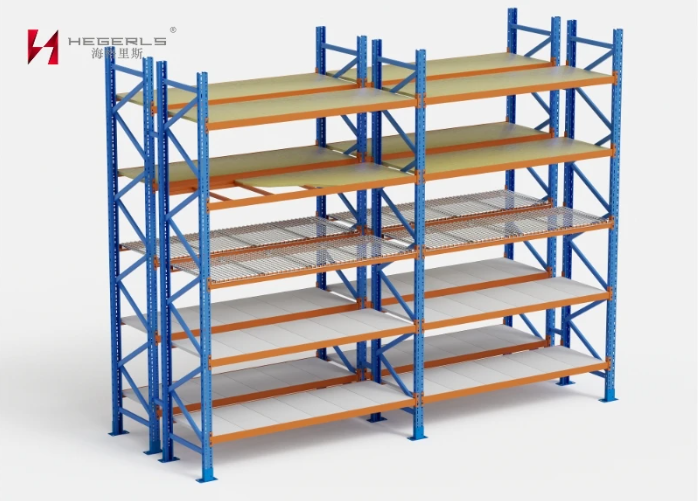
HEGERLS long-span shelving illustration
|
Shelving type |
Best suited to |
Main evaluation point |
|
Adjustable steel |
General parts, records, cartons and maintenance stock |
Shelf spacing, bracing and approved load |
|
Boltless or rivet |
Fast assembly and changing storage needs |
Deck type, span and connector engagement |
|
Long-span |
Bulky or heavier hand-loaded goods |
Beam span, deck support and handling ergonomics |
|
Wire |
Visible, ventilated storage |
Mesh opening, item stability and environment |
|
Bin shelving |
Small components and high SKU counts |
Bin size, labels and replenishment control |
|
Carton-flow |
High-frequency carton or piece picking |
Carton compatibility, lane testing and FIFO flow |
|
Mobile |
High-density small-item or archive storage |
Floor, controls, access frequency and egress |
|
Multi-tier |
Large SKU counts where clear height is available |
Structure, stairs, walkways, fire and evacuation |
Unlike pallet-oriented warehouse racking systems, shelving should first be evaluated around the hand-loaded item and the pick face. These categories can overlap. A multi-tier installation may contain steel or long-span shelving, and carton-flow lanes may be integrated into rack or shelving structures.
Adjustable steel shelving uses upright posts or frames with shelves repositioned at defined increments. It is common in stockrooms, workshops, maintenance areas and general warehouse picking because shelf spacing can be adapted to different cartons or parts.
Boltless shelving uses interlocking beams and posts rather than conventional nuts and bolts for the main assembly. It can be installed or reconfigured quickly and is popular for cartons, totes and light-to-medium industrial goods.
The HEGERLS long-span shelving system illustrates a beam-and-shelf configuration for hand-loaded goods. Long-span shelving bridges the gap between general shelving and pallet rack. It uses beams and wider shelf levels for bulky cartons, tools, tires, components or other goods that are still loaded manually.
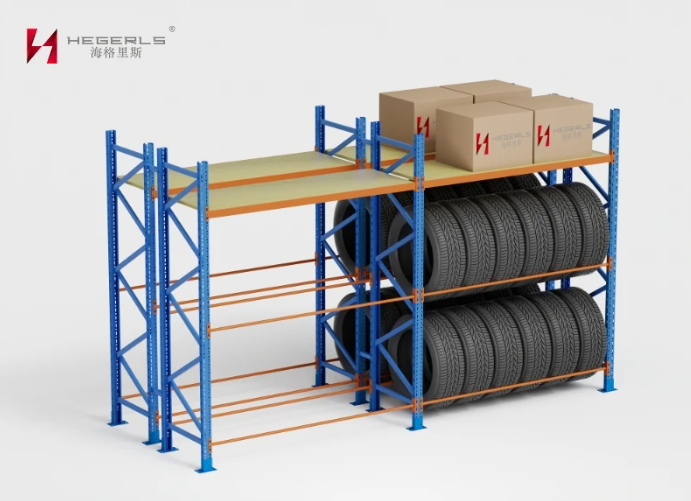
Long-span shelving illustrated with cartons and bulky tires.
Wire shelving uses open mesh shelves that improve visibility and air circulation and allow light to pass through. It is commonly used where cleanliness, inspection or frequent adjustment is important.
Bin shelving combines shelf levels with plastic or metal bins, drawers or dividers. It creates defined locations for fasteners, spare parts, electronic components and other small items with high SKU counts.
A carton-flow racking system uses inclined rollers or wheels to create a carton pick face. Replenishment occurs from one side, and cartons move toward the pick face as the front unit is removed. This can create a compact first-in, first-out pick face and separate replenishment from picking traffic.
Mobile shelving places rows on guided bases so the system opens only the aisle needed for access. By reducing permanently open aisles, it can increase storage density for archives, parts and low-to-moderate activity inventory.
A mezzanine racking system uses supported floors, walkways and stairs to create two or more manual picking levels. It can use available clear height without relying on tall manual reach and is useful for a large number of small SKUs.
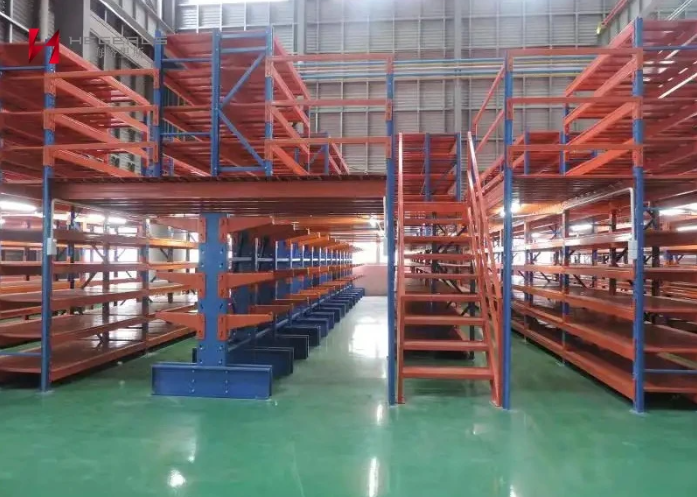
HEGERLS multi-tier shelving with stairs and walkways for access between levels.
Shelving normally supports hand-loaded inventory; pallet racking supports unit loads placed by mechanical equipment. Lower pallet-rack levels can sometimes be configured as carton pick faces, and long-span shelving can resemble light rack, so the boundary should be defined by approved load and handling method.
Many warehouses use both. Pallet reserve storage can replenish shelving or carton-flow locations, with fast-moving items kept near packing. The warehouse racking type guide explains pallet-oriented alternatives for reserve storage.
Begin with an item profile: dimensions, maximum weight, container type, quantity, SKU count and any security or environmental requirement. Then add the order profile, including picks per SKU, units per order, replenishment frequency and peak activity.
Map the work itself. Decide who loads and picks each level, which carts or devices enter the aisle and where completed orders go. Frequently selected goods should be easy to see and reach. Heavy items should remain in a suitable lifting zone, and deep shelves should not hide inventory.
Check the building for clear height, columns, doors, docks, floor capacity and condition, lighting, egress and fire protection. Compare alternatives by usable locations, pick travel, replenishment effort, installed scope and expansion, not by shelf count alone.
Finally, request documented shelf and bay capacities for the proposed configuration. Confirm whether anchors, bracing, dividers, bins, decks, guards, stairs, gates and installation are included. Trial the pick face with real items when carton behavior or ergonomics are uncertain.
Keep capacity information available and train users to load shelves evenly within the approved limits. Inspect for leaning frames, damaged posts, displaced beams, loose connections, deflected shelves and unstable goods. Correct the cause rather than simply moving the product elsewhere.
Include installation, training and maintenance responsibilities in the project scope. Do not add levels, change deck materials, mix incompatible parts or convert shelving to pallet storage without review. Reconfiguration can change bay capacity, stability, clearances and fire-protection conditions.
Adjustable steel or boltless shelving serves many general applications, but versatility depends on the approved load, shelf dimensions and accessories.
Long-span shelving is often suitable for bulky hand-loaded goods. Palletized or mechanically handled loads normally require pallet racking.
Carton-flow shelving can support FIFO movement when replenishment and picking occur from opposite faces and the packages travel reliably.
It can be, but opening one aisle at a time may limit concurrent access. Activity and user demand should be modeled before selection.
Provide item sizes and weights, quantities, SKU and order profiles, required pick faces, room dimensions, environment and planned handling methods.
Share your warehouse drawing, item data, SKU profile, order activity and replenishment method through the HEGERLS project enquiry page. These inputs help determine where shelving, pallet racking or a hybrid arrangement best supports the operation.