HEGERLS Warehouse Automation Solutions & High-Density Storage Systems

 read
read A stacker-crane AS/RS and a four-way shuttle system can both automate pallet storage and retrieval, but they organise movement differently. A stacker crane normally serves a defined aisle with horizontal travel, vertical lifting and a load-handling device. A four-way shuttle moves across a rail grid on each level and uses lifts for vertical transfer. The better option depends on the warehouse geometry, pallet and SKU profile, peak flow, resilience plan and future expansion—not on a universal ranking.
In this comparison, “AS/RS” refers mainly to a pallet stacker-crane system. Four-way shuttle systems are also a form of AS/RS in the broader sense.
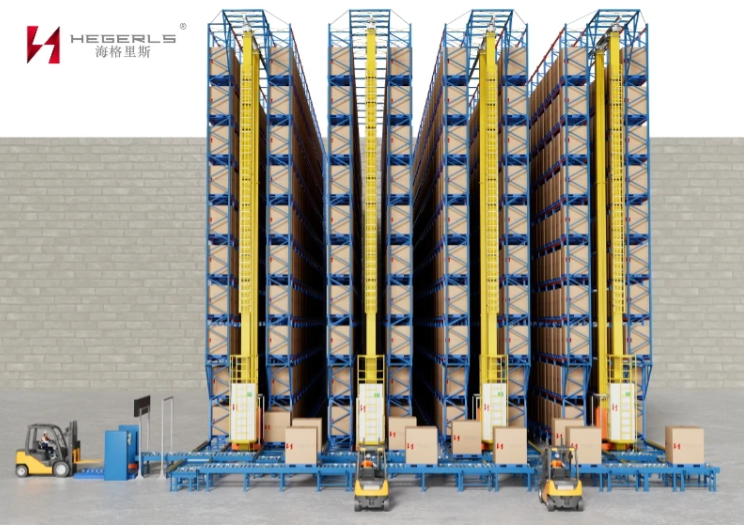
A stacker-crane AS/RS usually has one or more cranes travelling along fixed aisles between racks. Each crane handles horizontal travel, vertical lifting and pallet transfer. Single- or double-deep storage may be used, subject to load-handling design.
A four-way shuttle system uses multiple mobile vehicles within the rack grid. The vehicles travel in two horizontal directions, while lifts connect levels and conveyors or stations connect storage with receiving and dispatch.
This distinction changes how density, traffic, redundancy and expansion are engineered.
|
Decision factor |
Stacker-crane AS/RS |
Four-way shuttle system |
|
Main movement architecture |
Crane serves a fixed aisle and moves horizontally and vertically |
Shuttles move across levels; lifts provide vertical transfer |
|
Storage layout |
Defined crane aisles, often high-bay |
Dense grid with cross aisles, lifts and transfer points |
|
Throughput scaling |
Add cranes, aisles, load-handling devices or stations |
Add shuttles, lifts or stations within network limits |
|
Traffic management |
Mainly aisle and station sequencing |
Fleet routing, intersections, lift queues and station sequencing |
|
Fault containment |
A crane fault affects its served aisle or zone |
A vehicle can be isolated, but lift or network faults may affect larger zones |
|
Building fit |
Strong for planned high-bay, regular aisle geometry |
Flexible around some irregular layouts and phased rack blocks |
|
Best comparison method |
End-to-end simulation and acceptance test |
End-to-end simulation and acceptance test |
The table describes typical architectures, not guaranteed outcomes. Actual designs can combine cranes, shuttles, conveyors and other equipment.
There is no reliable answer without a layout. Four-way shuttle designs can remove long fixed crane aisles and create deep storage blocks. Stacker-crane systems can use considerable building height and narrow machine aisles. Either may provide more usable positions on a particular site.
Density is affected by:
Use at least three measures: pallet positions per square metre of storage area, pallet positions per cubic metre of usable envelope and usable operating capacity after slotting rules. A concept with more theoretical positions may store less real inventory if SKU fragmentation leaves deep lanes partly empty.
Throughput is the number of completed inbound, outbound or combined movements under defined conditions. It cannot be inferred from travel speed alone.
A crane cycles between transfer stations and storage locations. Performance is influenced by aisle length and height, acceleration, simultaneous horizontal and vertical movement, load-transfer time, storage depth, sequencing and the number of input/output stations.
One crane may provide a clear capacity boundary for one aisle. Multi-crane or multi-aisle layouts divide work, but the conveyor front end must feed and receive loads without creating queues.
A shuttle fleet can perform several horizontal tasks at once. However, vehicles share intersections, lifts, charging infrastructure and transfer stations. Poor task allocation can create congestion, while an undersized lift can make additional shuttles wait.
Fleet size should therefore be tested together with lift and station capacity. The useful question is not “How fast is one shuttle?” but “How many accepted pallet missions can the complete system finish during the agreed peak profile?”
Require suppliers to state:
Without common assumptions, two throughput figures are not comparable.
Scalability has several meanings.
Both systems can expand if structure, controls and interfaces are designed for it. A stacker-crane project may add aisles or extend a building. A four-way system may add rack zones or levels. Building permits, fire design, conveyor routes and software licences can constrain either plan.
Four-way shuttle systems are often described as modular because vehicles can be added. That is useful only while the rail network, lifts and stations have spare capacity. Beyond that point, another lift, station or storage zone may be required.
Stacker-crane throughput is more closely tied to crane and aisle architecture. Scaling may require another crane or aisle, or changes to the load-handling and front-end conveyor design.
A shuttle project may support staged fleet deployment. A crane system can also be phased by aisle or building section. The practical choice depends on whether construction, software integration and commissioning can be separated without interrupting live operations.
A design should show what happens after a fault, not only during normal operation.
In a stacker-crane system, a crane fault may isolate the inventory in its aisle unless an alternative access or recovery plan exists. The failure boundary is relatively easy to identify, but recovery access and spare-part strategy remain essential.
In a four-way system, one shuttle may be removed while other vehicles continue. This does not make the whole design automatically redundant: a shared lift, control layer, transfer station or network section can still be a single point of failure.
Compare maintenance access, rescue procedures, isolation zones, spare vehicles or components, remote support, backups and the expected capacity in degraded mode.
Stacker cranes are well suited to regular, high-bay aisle layouts. They require coordinated rails, racking, clearances, foundations or floor interfaces and transfer stations.
Four-way shuttle grids may adapt to some column patterns and irregular footprints by routing around defined areas. They still require precise rack geometry, lift locations, safe access, suitable floors or foundations and compatible fire protection.
For an existing building, survey clear height, slab capacity and flatness, columns, roof loads, utilities, docks, fire systems and installation access before selecting equipment.
Do not compare only crane price with shuttle price. Include:
The lower initial quotation may exclude a bottleneck, interface or acceptance obligation carried by another contractor.
If the concepts remain close, a hybrid design may be appropriate. For example, different storage zones can use different technologies according to load, velocity or temperature.
Yes, when it forms part of an automated storage and retrieval system. The narrower comparison in this article is four-way shuttle versus stacker-crane AS/RS.
It depends on the approved layout, height, lane depth, lifts, aisles, fire zones and SKU distribution. Compare usable pallet positions, not marketing percentages.
Either can provide the required throughput when properly configured. The answer depends on fleet, lifts, cranes, stations, travel profile and control logic.
Four-way fleets can add vehicles in stages, while crane systems can add aisles or zones. Both require spare structural, control and interface capacity.
Reliability depends on component design, redundancy, maintenance and recovery. Ask for availability assumptions and degraded-mode tests for the proposed architecture.
HEGERLS presents both stacker-crane AS/RS and four-way shuttle systems within its automated storage range. A defensible comparison requires the same layout, load, inventory and peak-flow inputs for both concepts.
Send your warehouse drawing, pallet data, SKU and inventory profile, inbound and outbound peaks, operating environment, software interfaces and expansion plan through the project enquiry page for concept discussion.