HEGERLS Warehouse Automation Solutions & High-Density Storage Systems

 read
Intralogistics solutions are the processes, equipment, software and controls used to move, store, identify and manage goods within one facility or company site. They connect receiving, storage, production supply, picking, packing and dispatch with the information needed to coordinate each movement.
The term is broader than warehouse automation. An intralogistics design may include manual work, forklifts, racking and software, or it may use conveyors, AS/RS, shuttles and robots. The objective is a reliable internal flow, not automation for its own sake.
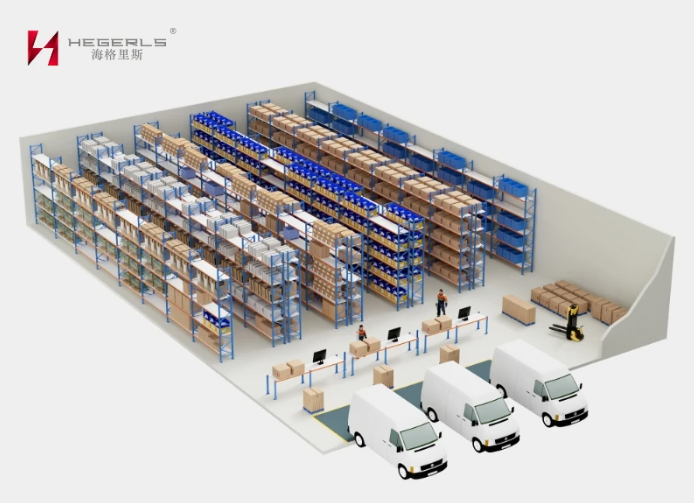
Illustration of warehouse storage aisles with packing areas and loading docks
Logistics covers the wider movement and coordination of goods across suppliers, production, warehouses, transport networks and customers. Intralogistics focuses on what happens inside a site.
For a distribution centre, the boundary may begin when a vehicle arrives at receiving and end when the finished shipment leaves the dock. In a factory, it may also include raw-material supply to production, work-in-process movement and transfer of finished goods to storage.
The boundary should be written into the project scope. Yard movements, docks, production lines and shipping buffers can fall between departments if ownership is unclear.
|
Process |
Typical activities |
|
Receiving |
Unloading, identification, checking, labelling and staging |
|
Putaway and storage |
Location assignment, transport, storage and replenishment |
|
Production supply |
Delivery of materials, work-in-process and empty containers |
|
Picking |
Person-to-goods, goods-to-person, batch, zone or wave workflows |
|
Consolidation and packing |
Order checks, buffering, packaging and labelling |
|
Sortation and dispatch |
Routing, sequencing, staging and loading |
|
Returns |
Identification, inspection, disposition and restocking |
|
Information flow |
Orders, inventory status and warehouse tasks, equipment status and exceptions |
A good design connects these steps. Improving one machine while leaving a downstream buffer or workstation unchanged may simply move the bottleneck.
Storage may use selective or high-density racking, shelving, mezzanines, pallet shuttles or AS/RS. The HEGERLS automated storage systems range includes shuttle and stacker-crane concepts for different load units.
Forklifts and tuggers provide flexible manual transport. A roller conveyor system suits compatible loads moving frequently along stable routes. AGVs follow defined routes, while AMRs can navigate more dynamically. The right method depends on distance, frequency, load, route change and traffic interaction.
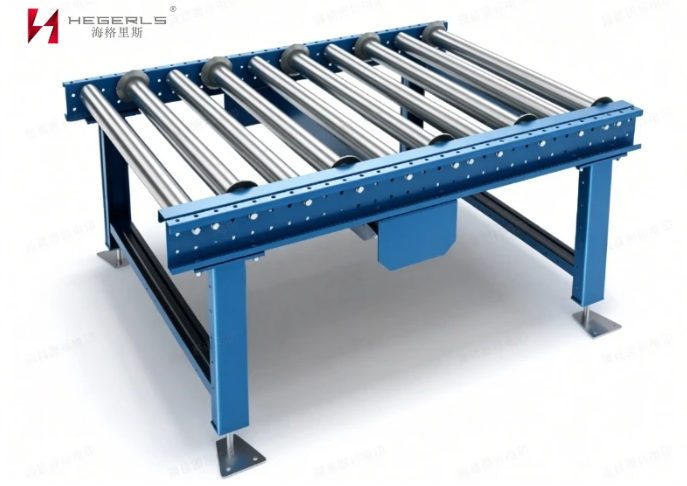
Blue-framed roller conveyor module with metal rollers and a drive unit
Solutions include manual shelves, carton flow, pick-to-light, voice direction, goods-to-person stations and robotic picking. Station design must consider replenishment, ergonomics, container handling, verification and exception work.
Barcodes, RFID, scanners, dimension checks, scales and sensors establish which load is present and whether it meets the process rules. Automation cannot compensate for inconsistent labels or unregistered movements.
A WMS manages inventory, locations, orders and business tasks. A control layer such as HEGERLS YUNTU-WCS coordinates equipment routes, status and faults. PLCs and equipment controllers handle machine-level actions. ERP, MES, TMS and carrier platforms exchange business or production data with the warehouse layer.
The warehouse automation guide explains this identify-decide-coordinate-execute-confirm chain in more detail.
Consider an outbound pallet. The ERP or order system releases demand. The WMS allocates inventory and creates a retrieval task. The WCS selects available equipment and coordinates a shuttle, crane, lift or conveyor. Controllers execute movements, sensors confirm each transfer, and the completion status returns to the WMS and host system.
The same architecture can include manual steps. A WMS may send a pick task to an operator, while a conveyor automatically transports the completed tote. The important point is that each handoff has a defined message, physical position, confirmation and recovery rule.
Master-data ownership should also be explicit. Item dimensions, locations, load identities, priorities and equipment status must use consistent definitions across systems, or apparently valid instructions can create physical exceptions on the warehouse floor.
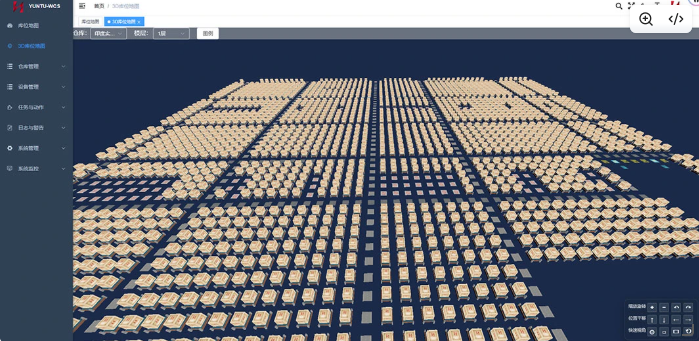
HEGERLS YUNTU-WCS interface illustrating the control-layer context
When correctly matched to the operation, intralogistics improvements can support more consistent material flow, better inventory visibility, reduced unnecessary travel, better use of storage space and clearer operational data.
These are potential outcomes, not automatic guarantees. Performance depends on the baseline process, data quality, system design, training, maintenance and how the facility is managed after launch.
A review is useful when internal transport consumes excessive time, storage and picking compete for space, queues appear between processes, inventory locations are unreliable, production waits for materials, or order growth exceeds the present flow.
New buildings are not the only opportunity. Brownfield facilities can improve a defined area or bottleneck while maintaining a long-term architecture for software, buffers and future equipment.
● Map every material and information flow from entry to exit.
● Define load units, dimensions, weights, identification and quality variation.
● Record average and peak volumes by route and time window.
● Mark queues, travel, manual decisions, rework and exceptions.
● Survey the building, fire constraints, floor, utilities and working areas.
● Define ERP, WMS, WCS, MES and equipment data ownership.
● Compare manual, semi-automated and automated concepts using the same inputs.
● Test normal flows, peak demand, component faults and manual recovery.
● Assign installation, commissioning, training, support and change-control responsibilities.
HEGERLS describes planning, system implementation, software integration, training and support within its warehouse automation services. The exact scope must still be agreed for each project
No. Intralogistics covers all internal material and information flows; warehouse automation is one way to execute selected parts of those flows.
Examples include racking, conveyors, sorters, lifts, shuttles, stacker cranes, forklifts, AGVs, AMRs and picking workstations.
Common layers include ERP or MES, WMS, WCS or WES, PLCs, equipment controllers and identification systems.
Yes. Layout changes, slotting, scanning, standard work, racking and selective mechanisation may solve a bottleneck without full automation.
Prepare process maps, load data, SKU and inventory profiles, route volumes, peaks, building conditions, software interfaces and expansion plans.
Send your process map, warehouse or factory layout, load-unit data, inventory profile, route volumes, current systems, constraints and target timeline through the HEGERLS project enquiry page. These inputs provide a basis for defining system boundaries and comparing concepts.