HEGERLS Warehouse Automation Solutions & High-Density Storage Systems

 read
read Warehouse conveyor systems move pallets, cartons, totes or other defined load units between receiving, storage, picking, packing, production and shipping processes. A suitable system is not chosen by conveyor speed alone. It must match the load, route, required flow, accumulation rules, transfer points, controls, safety measures, maintenance plan and future operating changes.
HEGERLS groups conveyor and sorting equipment around pallet, carton and tote movement, sorting, lifting, turning, buffering and positioning. The final configuration still depends on project-specific loads, layout and interfaces.
A warehouse conveyor system may include more than a straight powered line. A complete design can combine conveyor sections, supports, curves, transfers, lifts, sensors, scanners, drives, guards, control panels, software interfaces and operator stations. It may also connect with an AS/RS, pallet shuttle, stacker crane, robot, packing machine or dock process.
The system boundary should be explicit. One quotation may cover only mechanical conveyor modules, while another includes electrical controls, safety devices, WCS integration, installation and acceptance testing. These offers are not directly comparable until exclusions and interfaces are aligned.
The load is the first design input because each conveyor type supports loads differently. Record the following for every pallet, tote, carton, tray or container family:
A nominal weight is not enough. A light carton with a flexible base can behave poorly on widely spaced rollers, while a damaged pallet may fail at a transfer. Check representative samples on the proposed roller pitch, belt surface, guides and transfer geometry.
Draw the material flow from origin to destination. Include receiving lanes, inspection, storage interfaces, replenishment, picking, packing, quality checks, reject locations and shipping buffers. For every movement, record the direction, frequency, priority and decision point.
This map exposes requirements that a floor plan can miss, such as accumulating before a lift, merging streams, diverting unreadable loads or releasing pallets in sequence. Also mark people, forklifts, emergency routes, maintenance access, fire exits, columns, doors and workstations.
The correct choice depends on the load contact surface, required control and operating environment. A project may use several technologies rather than one type throughout.
|
Conveyor or device |
Typical use |
Main evaluation points |
|
Gravity roller |
Manual or gravity-assisted movement of rigid loads |
Slope, load base, braking, operator effort and end stops |
|
Powered roller |
Zoned transport and accumulation for cartons, totes or suitable pallets |
Roller pitch, zone length, drive method, controls and accumulation logic |
|
Belt conveyor |
Small, irregular or soft-bottom loads requiring continuous support |
Belt material, tracking, incline, transfer gaps, cleaning and tensioning |
|
Chain conveyor |
Pallets or rigid unit loads with defined support points |
Chain strands, pallet orientation, transfer geometry, lubrication and guarding |
|
Pallet roller conveyor |
Pallet transport along defined routes |
Pallet quality, load stability, accumulation method and forklift interfaces |
|
Transfer unit |
Direction change between intersecting lines |
Lift stroke, cycle sequence, load support and sensor positions |
|
Vertical lift or elevator |
Movement between elevations or floors |
Interface levels, guarding, queue capacity, recovery and maintenance access |
|
Sortation device |
Routing loads to multiple destinations |
Identification quality, destination logic, reject handling and downstream capacity |
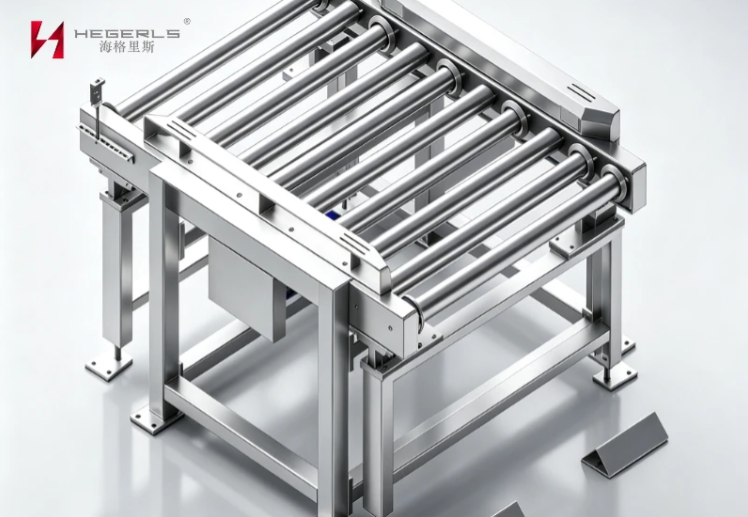
The HEGERLS roller conveyor system page shows a modular structure with frames, rollers, drives, controls, sensors and safety components. Model-specific capacity or speed must be confirmed in the project specification. For other technologies, verify continuous support, pallet contact points, transfer gaps, cleaning, guarding and fault-recovery behavior against the actual load and route.
Start with a flow profile by route and load type. Record average volume, peak volume, peak duration, shift pattern, planned breaks and seasonality. Daily totals can hide short periods when receiving, picking or shipping demand is much higher.
Convert demand into required load releases for each operating window, then include scanning, transfers, merges and operator work. Nominal belt or roller speed is not system throughput because loads require spacing and zones remain occupied during downstream cycles.
Accumulation should have a purpose. It may decouple two processes, protect a workstation from surges or hold loads before an automated storage interface. Specify how many loads each buffer must hold, whether contact between loads is acceptable, how priorities are released and what happens when the buffer is full.
Identify the bottleneck for each route. A fast main line does not solve a slow lift, sorter, scanner, transfer or manual station.
Verify the layout against measured building data, including clear height, floor levels, columns, docks, doors, fire protection, egress, forklift aisles, supports, cabinets and maintenance space.
Every handoff needs an interface definition. For a conveyor connected to storage equipment, define load position, elevation, orientation, release signal, readiness signal, timeout, fault response and recovery procedure. Mechanical alignment alone does not create a reliable interface.
At forklift or operator handoffs, review equipment protection, positioning, reach, working height, lighting and safe jam access.
Conveyor controls typically use sensors and programmable controllers to start, stop, accumulate, merge and divert loads. A WCS may coordinate routes and equipment tasks, while a WMS manages inventory and business workflows. The exact allocation varies by project, so the functional specification should state which layer owns each decision.
The HEGERLS YUNTU-WCS is presented as an execution layer between management software and automation equipment, including conveyors. For a project, confirm the actual interface method, message fields, equipment list, response timing, alarm ownership, retry logic and manual recovery modes.
Useful control questions include:
Conveyors introduce pinch, nip, crush, entanglement and struck-by hazards. OSHA warehouse guidance calls for regular inspection, guarding of pinch points, lockout procedures and training, along with suitable lighting and working surfaces around conveyors. Applicable legal and technical requirements depend on the project location and equipment.
The concept should address guarding, emergency stops, warning before start-up, safe crossings, access under elevated conveyors, stored energy, jam-clearing procedures and isolation points. Safety functions must also be included in commissioning and operator training.
CEMA publishes conveyor technical and safety resources covering subjects such as crossovers, emergency stops, spill guarding, barriers and installation. These materials can support design review, but the project still requires qualified engineering and compliance with local regulations.
Ask how technicians will reach motors, chains, rollers, sensors and control panels. Review maintenance tasks, lubrication points, wear parts, recommended spares and diagnostics. Recovery procedures should cover sensor misalignment, damaged loads, full downstream zones and communication loss.
Supplier scope should cover the relevant lifecycle stages. HEGERLS lists planning, design, equipment manufacturing, installation, commissioning, training and after-sales support on its warehouse automation service page. The contract should still define the exact deliverables, response arrangements, documentation and spare-parts responsibility for the specific project.
Factory acceptance testing and site acceptance testing should be based on agreed functions and representative loads. A useful test plan may include:
Define how results will be measured and who approves exceptions. Testing only ideal samples does not prove that the system can handle normal variation.
Create a compliance matrix so every proposal responds to the same process, load, capacity, interface, safety and testing requirements. Separate included scope, options, exclusions and customer responsibilities.
Compare the following items:
This method makes commercial differences easier to understand and reduces the risk of choosing a lower initial price that excludes essential integration or testing work.
Fixed conveyors are effective for repeatable flows between stable points. They may be less suitable when routes change frequently, floor access must remain open, volumes are low or products cannot be standardized. Manual handling, forklifts, tugger trains, AGVs or AMRs may be alternatives for some movements.
The choice does not have to be all or nothing. A warehouse can use fixed conveyors on high-volume, stable routes and flexible transport for variable routes. Compare options using the same load, flow, safety, staffing, interface and lifecycle criteria.
Provide load dimensions, weights and base construction, route map, average and peak flow, accumulation needs, building constraints, interfaces, environment and operating schedule.
Pallet roller and chain conveyors are common options. The correct choice depends on pallet runner direction, base quality, weight, stability, transfer method and route.
Throughput is evaluated from the required release rate, load spacing, zone occupancy, device cycles, route sharing and downstream constraints. Conveyor travel speed alone is not an end-to-end capacity figure.
Yes, when equipment signals, task logic, identification, routing, alarms and recovery responsibilities are defined and tested across the control layers.
Test representative loads, every required route, peak scenarios, scans, accumulation, interfaces, safety functions, faults, recovery, manual modes and documentation handover.
To evaluate a conveyor project, prepare the warehouse layout and clear height, load dimensions and weights, pallet or container base details, route map, average and peak flow, operating environment, existing WMS or ERP, connected equipment and target implementation schedule.
Send these inputs through the HEGERLS project enquiry page for a project-specific discussion. Capacity, equipment selection, interfaces and scope should be confirmed through engineering review rather than assumed from general product information.

