HEGERLS Warehouse Automation Solutions & High-Density Storage Systems

 read
A warehouse control system, or WCS, is software that coordinates the real-time execution of automated material-handling equipment. It receives tasks from a WMS or other host, selects routes and resources, sends instructions to equipment controls, monitors status and reports task completion or faults.
A WCS does not replace every machine controller or manage the complete inventory business process. It sits between higher-level warehouse software and equipment such as conveyors, sorters, shuttles, stacker cranes, lifts and robots.
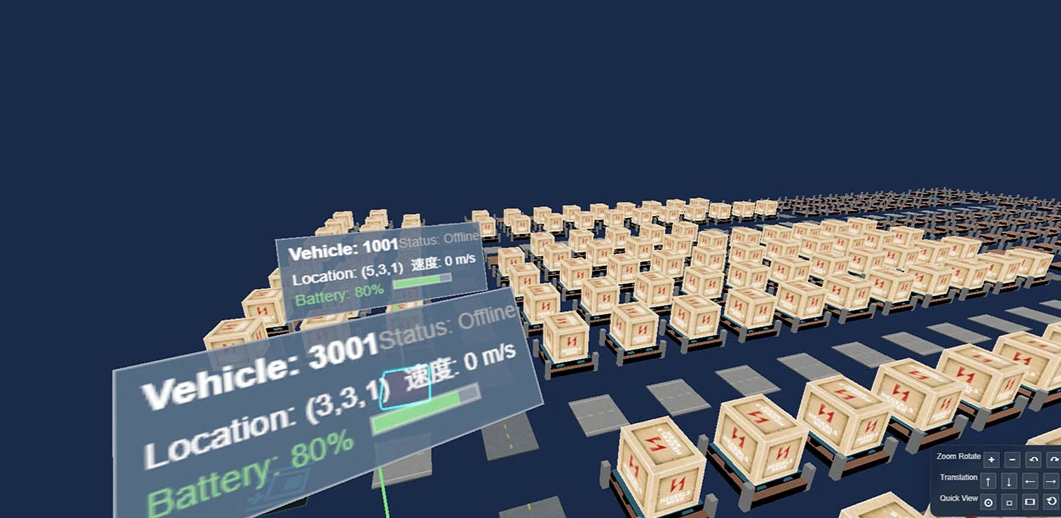
WCS Demonstration Diagram
Consider an outbound pallet. The WMS identifies the inventory and releases a retrieval task. The WCS receives the source, destination, priority and load identity. It checks equipment availability, assigns the task and coordinates the required shuttle, crane, lift and conveyor route.
Equipment controllers execute the movements and sensors confirm positions or handoffs. The WCS tracks progress, responds to route conditions and returns completion or exception status to the WMS. The inventory record is updated only when the agreed confirmation point is reached.
The cycle can be summarised as receive, validate, schedule, route, execute, monitor and confirm. Each step needs rules for duplicate messages, timeouts, blocked destinations, unreadable loads and equipment faults.
| Function | Typical WCS responsibility |
| Task allocation | Assign work to an eligible equipment zone or resource |
| Routing | Select conveyor, shuttle or transfer paths |
| Sequencing | Release loads in the order required by downstream processes |
| Traffic control | Prevent conflicts at intersections, lifts or shared paths |
| Load balancing | Distribute work where several routes or machines are available |
| Status monitoring | Collect availability, task, alarm and position information |
| Exception handling | Stop, reroute, retry or escalate according to defined rules |
| Host communication | Exchange tasks and confirmations with WMS, WES or other systems |
| Reporting | Present equipment and material-flow status for operations and support |
The HEGERLS YUNTU-WCS is described as coordinating four-way shuttles, stacker cranes, AGVs, lifts and conveyor systems. Exact supported equipment, interfaces and recovery functions should be confirmed for each project.
| Layer | Primary role | Typical time horizon |
| WMS | Inventory, locations, orders and warehouse business tasks | Minutes to days |
| WES | Work release and execution optimisation across people and automation | Seconds to hours |
| WCS | Real-time coordination of automated material flow | Immediate execution |
| PLC or device controller | Direct control of motors, sensors, interlocks and machine sequences | Machine cycle |
These boundaries are not universal. Some WMS products include execution functions, some WCS products perform advanced scheduling, and some equipment vendors provide their own subsystem controls.
The project architecture should state which system owns inventory status, task priority, routing, equipment availability, alarms, safety signals and final confirmation. The HEGERLS CC-WMS provides the management-layer context for receiving, storage, inventory and outbound workflows.
A WCS may connect with conveyors, sorters, pallet checks, print-and-apply stations, shuttles, stacker cranes, lifts, carousels, AGVs, AMRs, robotic cells and goods-to-person workstations.
Connection does not mean every device uses the same protocol or control depth. One subsystem may accept high-level missions, while another requires detailed route commands. The interface list should define messages, timing, ownership, error codes and test responsibility for every equipment family.
A manual warehouse normally does not require a dedicated WCS. Operators can receive tasks directly from a WMS through scanners or workstations.
A WCS becomes relevant when several automated devices must share tasks, routes, lifts, buffers or stations. It is especially useful where equipment from different suppliers must work as a coordinated material-flow system.
The need depends on architecture rather than warehouse size. A compact facility with complex sortation may need a WCS, while a large manual building may not.
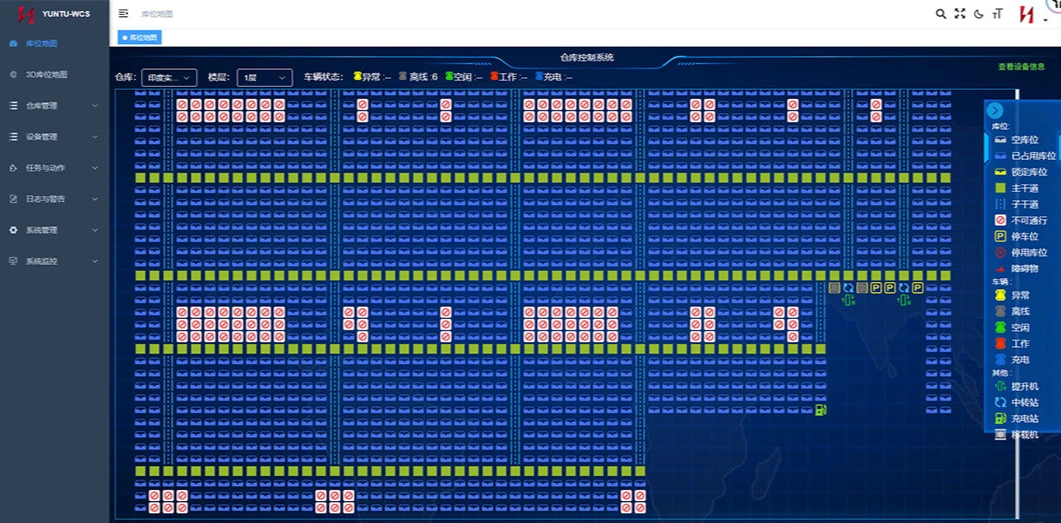
WCS Management Console
Normal-path demonstrations are insufficient. Test what happens when a barcode cannot be read, a pallet fails a dimension check, a destination is full, communication is lost, a lift stops, a shuttle needs recovery or a task confirmation is duplicated.
Define whether the WCS retries, reroutes, pauses upstream flow, sends an alarm or requests manual action. Operators need clear visibility into load identity, current location, task state and permitted recovery steps.
Cybersecurity and change control also matter. User access, network zones, backups, logs, remote support, software versions and interface changes should be documented. An equipment upgrade should not silently break the control chain.
Commissioning should trace each message to a physical event. Teams need to confirm when inventory ownership changes, which system can cancel a task and how the operation reconciles loads after a restart.
● Map every automated route, handoff, buffer and decision point.
● Define equipment ownership and supported communication methods.
● Specify host messages, acknowledgements, timing and retry behaviour.
● Model average, peak and fault-mode workloads.
● Confirm alarms, logs, dashboards and operator permissions.
● Test normal tasks, exceptions, manual recovery and restart after interruption.
● Review scalability for added devices, zones, routes and software releases.
● Agree on FAT, SAT, training, support and long-term change responsibility.
The warehouse automation guide provides the broader context for data capture, management, control and physical execution.
No. WMS manages inventory and business workflows; WCS coordinates real-time automated equipment execution.
It can receive tasks from another host in some architectures, but inventory ownership and business priorities still need a defined system.
No. A WCS coordinates multiple devices or subsystems, while PLCs and controllers execute machine-level logic and interlocks.
WES usually adds broader work release and optimisation, while WCS focuses on equipment coordination; actual product boundaries vary.
Use representative peak flows, route conflicts, equipment faults, message interruptions and recovery scenarios with measurable pass criteria.
Prepare the equipment list, process flow, peak tasks, WMS or ERP interfaces, network requirements, alarm ownership and recovery scenarios. Send these through the HEGERLS project enquiry page so the control scope can be reviewed against the actual automation architecture.